Search This Blog

Saturday, 3 March 2012

Caste and Exploitation in Indian History: Bharat Patankar


Caste and Exploitation in Indian History: Bharat Patankar

by Ahilan Kadirgamar
Guest post by BHARAT PATANKAR translated by GAIL OMVEDT

Introduction: The Process of Exploitation
Exploitation arising from the caste hierarchy is a particular feature of the South Asian subcontinent. There was no such exploitative system in other continents or in countries outside of South Asia. But since caste exploitation has been a reality for 1500-2000 years this shakes the belief that only class can be the basis of exploitation. And because of this we have to transcend the attempt to find a way only pragmatically and deal with the issue on a philosophical and theoretical level. Class has been theorized extensively in terms of exploitation; to some extent gender also, but not caste. Exploitation as women in various forms has also been a reality for thousands of years; this also is not through “class”. This reality from throughout the world gives a blow to the idea that exploitation can only be class exploitation. This can also be said of exploitation arising on the basis of racial and communal factors.
By exploitation we mean the extraction of surplus from labour by those who do not themselves labour. The process of exploitation is not a process in the cultural or social fields. The process of exploitation can only come through the relations that exist among various human beings while creating new products in the process of production.  It is not a historical fact that these relations are those of exploitation everywhere and among all humans. Exploitation is not an “eternal” fact and will not necessarily exist in the future. In the matriarchal society the relations of production were not those of exploitation.
A system in which production gives more than is necessary for an abundant existence is one in which “surplus” is created. Such surplus is fundamental for a society of varied production. When the productive forces give more than the food that is necessary to live on, then there is a surplus created. When this happens then some humans are freed from simply producing food. They can do such work as creating clothes and tools. After producing the food or clothes necessary for themselves they can then produce for others. The others may do varied forms of production, or take leisure, or devote themselves to art and philosophy. Thus a “social division of labour” is born. There is no necessity that this must be one of hierarchy or exploitation. Initially it is one of exchange.
However, when some people seize the “surplus” created in this situation, exploitation begins. Or, when those who are direct producers get simply enough to stay alive rather than the goods for an abundant life, and the rest is grabbed as “surplus” then exploitation begins. Thus arises a social division of labour based on exploitation.
Such an exploitative social division of labour may be based on class, on caste or on gender relations. In Hindustan the characteristics of a division of labour based on caste exploitation can be seen from about 600 BC. However this division of labour based on caste exploitation became triumphant, fixed and general only from about 600 AD.
The General Characteristics of the Caste System
Dr. Ambedkar had argued that the form of this exploitation was that of an “unequal hierarchy“. It was an exploitative hierarchy for the extraction of surplus. The fundamental unit of this division of labour is the caste. Its general characteristics are as follows:
1.    Beginning from the lowest caste in the hierarchy, while giving a small share of the surplus to every level of the hierarchy, the greatest share goes to the top.
2.    What is fundamental to the relations of exploitation is that in the division of labour the surplus from every level goes first to the level above it and then is channeled further “upward.”
3.    In the division of labour all the castes which participate in direct production can be called “toiling castes”. The proportion of people of the society in these castes is greater than 90%.
4.    Apart from the lowest castes among the toiling castes, the “toiling castes” all participate in the “exploitation” of the castes in the rung below them.
5.    It is a special feature of exploitation in the caste hierarchy that there is a mechanism for providing the greatest share from this internal exploitation among the toiling castes to the higher “exploiting” castes.
6.    Because of these characteristics, Dr. Ambedkar had said in regard to the internal division of labour in the caste exploitative hierarchy that it was actually a “division of labourers”.
7.    The type of work that people in the castes at each rung of the hierarchy was to do was ordained from generation to generation by birth; this is a special authoritative type of feature of the exploitation of the caste hierarchy.
8.    Besides this, there exists:
a)    The compulsion to marry within the caste;
b)    Caste-wise residence;
c)    Dining only within the caste;
d)    Exchange of daughters only within the caste;
e)    Decisions regarding the internal affairs of each caste through its caste panchayat;
f)    The principle of deciding caste by birth.
9.    The lowest castes will do the work considered dirtiest and requiring the most physical labour (these were the castes that were previously considered untouchable).
  • The toiling castes above these do comparatively less polluting and fully physical labour (the farming castes and the artisans who were not considered fully untouchable).
  • The castes in the rung above these do not do physical labour. They will do the planning, organisation, deciding rules, and organising of the mechanisms of violence (the castes considered to be “kshatriyas”).
  • The Brahman castes on the highest level will do no kind of physical labour.  This caste will have a full monopoly of the mental field (taking and giving of knowledge). Not only will they do no type of work understood to be “polluting”; they will not even go near it.
These are features that underlie the “laws of motion” of the caste system. Marxists refer to the “laws of motion” of a class-based economy, but the same concept can apply here.
The Laws of Motion of the Caste System
In regard to the reality that comes to view in connection with caste exploitation it is extremely important to distinguish the external features and the laws of motion. The external features of any exploitative system do not remain completely the same for the mode of production of that system in every era. But its laws of motion must remain the same. If they do not, then that system is broken. This happens inevitably.
If we consider this, then the laws of motion which must continue for the hierarchical exploitation of this system to go on appear to be the following:
1.    The caste of a person in the hierarchy is determined by the caste level of that hierarchy.
2.    The castes doing the most polluting, dirty and most heavily manual labour and the least mental work are at the very bottom, and to the extent that the “polluting” nature of work and the severity of its toil becomes less and the mental aspect increases, the level of the caste in the hierarchy will rise.  The castes at the highest level will hold a monopoly of mental work and will do no “dirty” or physical labour.
3.    Due to the form of exploitation in the caste hierarchy the situation of the “division of labourers” is created.
4.    A different form of hierarchy from that of the relations of class production is created, one in which there is a basis for each caste considering itself superior to those below it in the hierarchy.
5.    Without breaking these “laws of motion,” even if other characteristics of the caste system vanish, still as a system caste will not be annihilated.  It will continually be recreated and reproduced.
The Link of the Caste system to Class in the Capitalist System
Though the caste system as a system exists today, and though its laws of motion are reproduced from second to second, still its hierarchy has been joined completely and firmly to the capitalist relations of production. Since this linkage is integral and encompassing, without a movement to end the class system, there can be no effort to “independently” destroy the caste system.
1.    In the country, and Maharashtra, those who as sweepers fought as exploited workers, for an “eight hour day” are 100% drawn from the previously low castes. In doing such work, along with the laws of class exploitation, the laws of motion of the caste hierarchy apply. There are thus two sorts of exploitation, and it is not possible to destroy them in separate stages. This linkage is also seen with the fourth-class employees who collect waste, glass, paper etc.
2.    Those who work as porters in the railways, carrying heavy burdens and doing all kinds of physical toil in the cities are included among “unorganized” workers. Here the previous farming castes (Marathas, Dhangars, Kunbis etc.) work. Here also the principles of caste exploitation on the one hand and class exploitation on the other apply. In this connection also there can be no separate fights. The majority of these castes work in the rural areas as toiling farmers, agricultural labourers. It is also necessary to take account of the fact that among them 3-4% have become capitalist farmers, cooperative barons, small industrialists.
3.    The capitalist class in the country has primarily emerged out of castes of Brahmans, banias, and khatris (Ksatriyas). Within it some 1-1 ½ % come from farming castes, artisan castes to become small capitalists. In fighting with these capitalists it is clear that the struggle has to be both for the annihilation of caste and class.
4.    In today’s ultra-modern imperialist system based on “intellectual property rights” the people who monopolize a pure intellectual field such as computer software and hold a main position in areas from state administration to big companies have come mainly from Brahman castes. This is also true of the financial field. Here also there is an integral connection between class and caste. A dual struggle will have to be given in this respect.
5.    Aside from the Brahmans, banias and Thakurs who are considered Ksatriya castes, about two to five percent of the people of the toiling castes have become capitalists, capitalist farmers, cooperative barons, or professionals in high level intellectual fields. This section will not take part in a fight for the annihilation of caste. Only a few individuals from them may possibly become part of the struggle. This is a result of the ultra-modern capitalist class reality.
A Historical View: the Need for Struggle against Brahmanic Religion and Culture   
Brahmanic culture and religion has functioned for 1500-2000 years to give a firm foundation for the hierarchical exploitative caste system. From the time of Gautam Buddha up to today there have been many struggles against this culture and religion.  Alternatives have been given. Buddhist Dhamma expelled brahmanic religion and culture from the main trend of the social structure Indian subcontinent for a long time.   Buddhist Dhamma and Jain religion remained as the main trends for a thousand years in this country. But once the caste structure became fixed, the place of Buddhism as the “mainstream” began to end; it could not prevent the solidification of the caste system.  As long as the production system based on the exploitation of the caste hierarchy is reproduced, no great blow can be given to brahmanic culture and religion. This exploitative system has continuously reproduced both of these. Because of this the struggle for the annihilation of caste must go on two fronts – that of the material productive system, and that of culture.
Brahmanic culture has in the last 2-3 thousand years had a major effect on the society and its people. But in this lengthy period it has also tremendously changed; along with the eras of various modes of production change, so brahmanic culture has adapted and changed itself. It has attempted to shape itself to suit the ideology of the newly coming modes of production. Except for the nearly thousand years of hegemony of Buddhist Dhamma, brahmanic culture has remained dominant in Hindustan.
It appears that in the period of the decline of the Indus civilization brahmanic culture first began to gain hegemony in some parts of the subcontinent. It is proclaimed in the Purush Sukta of the Rig Veda (dated to about the 10th century BC) that from the sacrifice of the original “Purusha” the Brahman came from his mouth, from his arms the Kshatriya, from his thighs the Vaishya and from his feet the Shudras. The ideology of the superiority of Brahmans and the hierarchy of superiority and inferiority dates from this period. But such four varnas were not existent throughout the south Asian subcontinent. In some places there were three varnas, in some two and in some the Sangha-ganas of only one varna existed. Aside from the Sangha-gana of one varna, the Kshatriya, in the other varma forms there was a clear superiority of Brahmans. But in the majority areas of the subcontinent these varna types did not exist. In most areas there was no exploitation based on the hierarchy of a varna system or class system. In these areas, adivasi communities existed. There were some doing settled agriculture, some living by hunting and gathering food, grains and fruits, and some shifting cultivation. Among these the majority must have been matriarchal or matrilineal. The one or more varna systems with brahmanic hegemony existed only among those doing settled agriculture. In some of these areas, kingdoms began to appear around the time of the Buddha.
After the defeat of the matriarchal or matrilineal communities, the first exploitative systems founded on patriarchy and the exploitation of women could be found also in the non-kingly sangha-ganas. Later, societies based on kingship emerged. With the rise of agricultural production and commerce, paid “karmakaras” or labourers began to appear as the basic exploited toilers. In the beginning of the period of Buddhism the kingdoms were growing. On one hand, destroying the sangha-ganas, these kingdoms cleared the forests where adivasi communities residing and forcibly turned them into settled agriculturalists, collecting revenue from them. This created the “kutumbin” farming class. The shrenis of artisans began to be formed in the large cities; their heads of families began to be known as “gahapatis.”  Artisans organized in shrenis and as labourers in the cities and in the rural areas the agriculturalist “kutumbins” were the main producers, with dominant people, the “shreshtis,” taking the production from agriculture. This was the general structure of society. This was also the period of in which the land, forests and mines were under control of the kingly states. Their administration developed the roads and irrigation systems.
With the decline and end of this state power, the caste system originated in the society it had ruled.  By the time of about the sixth century it was solidified and generalized, and with this the hegemony of Buddhism ended and the hegemony of brahmanic culture and religion was established. The defeated adivasi communities and clans now began to be settled as “kutumbin” farmers doing agriculture, and with this their various kinds of work were determined. In this way the exploitation of the caste system, and the hierarchy of superiority and inferiority took birth with the changes in the mode of production. In addition, a new form of brahmanic culture consistent with this became established in the place of the old forms of brahmanic culture. A new brahmanic religion became created. In the beginning of this period, in the time of the nomadic warlike Vedic Aryans, Indra was regarded as the “hero” who led the battle against asuras and rakshasas – the indigenous peoples. Along with such personalized gods as Indra, elements like the earth, water, fire and sky were seen as divine. The yagna which reclaimed the superiority of Brahmans was central to religious practice.  Cattle were sacrificed, and horses also. With this, all the “twice-born” varnas also were of course eaters of beef. The Brahmans did the hegemonic work of legitimizing the varna system and applying its restrictions, and of controlling the snatching of the surplus of production so that it went to the twice-born varnas.
Brahmanic culture was sidelined during the period of the hegemony of Buddhism. Though in this period the “das” or slave system came to an end and the ideology of brahmanic culture was proclaimed in the Manusmriti, still it did not gain dominance in the field of direct production. For this system was based on wage labour, on kutumbin farmers paying revenue, and gahapatis in the large cities. The ideology of this society was largely drawn from Buddhism. But from the decline of this society and the rise of brahmanic kingdoms, the caste exploitation began to grow. An ideology of a fully developed caste-based society could not be created from Buddhism which completely opposed caste. And so this ideology and Dhamma began to be sidelined. Because of this the dominance of brahmanic religion and culture once again became created. However, the base and shape of both of these became to be largely transformed at this time; new deities were adopted, often from indigenous traditions. Of course, the legitimation for exploitation based on superiority and inferiority remained permanent.
The yagna and sacrifice of brahmanic religion in this period was declining.  Brahmans became completely vegetarian. New gods emerged. Indra and the five principles were sidelined. Puranas were written and a false history created. The imaginary fables of the Ramayana, Mahabharat became of huge importance. A “book” known as the Gita began to be praised. Krishna is shown as saying in this Gita that “I was the one who created chaturvarnya on the basis of guna and karma,” and is treated as the avatar of Vishnu who supposed preserved the universe. Such books as the Vedas and Upanishads fell into oblivion. Although some sections of the Vedas were taken where necessary to support the caste and varna system, these books no longer remained the foundation for brahmanic religion. The Manusmriti was brought forward as a weapon to establish in a strong way the exploitation of the caste system.
From village to village social and cultural relations began to be born which directly brought caste exploitation. The Puranas, Ramayana, Mahabharat and of the Manusmriti and all were brought forward to legitimize and give shape to this exploitation. Under the dominance of the fully superior Brahman caste, people were taught that one should behave according to the position giving in the caste hierarchy and make to effort to do anything different. One should carry out the “duty” of one’s caste. There will be punishment if the rules of caste are broken.
It was in the general era of brahmanic dominance that finally, imperialism in the form of British colonialism intervened. Imperialism made it possible for the capitalist mode of production, the capitalist form of state power and ideology to begin to develop. In this new reality, Brahmanism once again began to change. In today’s era, brahmanic culture and religion has taken new form through these changes. Without understanding this, it is impossible to understand what kind of alternatives the cultural movement can give in order to annihilate the exploitative hierarchy of caste.
The brahmanic culture of this age has made a special intersection with imperialist capitalist and national capitalist culture. Because of this such practices go on as the dances of Michael Jackson, a corrupted copy of western-style dancing in marriage processions and in the sinking of the Ganpati idols, the garba, the commercialization of women as market objects and practices understood to be low according to the old system.
The concept of calling the brahmanic religion as “Hindu religion” has become established. Originally “Hindu” was a geographical conception. The people living in the area from the region of the Indus river to the east, north and south were described as “Hindus” by the Persians. In their language “S” is pronounced as “H” for example, “Asura” had become “Ahura”. Thus the Muslims knew the subcontinent as “Al-Hind” or “Hindustan”. Its people were called Hindus; the term had nothing to do with religion. But during the British period the meaning was changed, to become a religion – with the implication that “Hinduism” is the “national” religion of people of the subcontinent.  Because of this very clever and far reaching attempt, even while maintaining the oppression from brahmanic religion and the brahmanic rules that establish what is high and low, the brahmanic religion has been able to carry out the effort of making the oppressed castes themselves participate in the ideology of their oppression, using such slogans as “Hindus are all one”.
In reality in the expansive region of Hindustan the religion practiced by the people is completely different form Hindu religion. Festivals such as Bendur (Bailpola), “Ghat basavane”, Hatga and others are considered important by these people. No basic “religious book” has said anything about following these festivals. The “Kulswamis” male or female, honoured by these people as their own particular deities are not mentioned in these religious books. Because of that the brahmanic religion that is called “Hindu religion” today has an uneasy coexistence with the elements it claims. It hides in fact what is a different religion. These two religions scorn each other completely. The brahmanic hegemony that exists over the non-Brahman people is primarily in connection not so much with religious practice, but with the high-low caste hierarchy. Because, though the brahmanic religion has continuously functioned to give cultural support to this exploitative hierarchy. It has also taken strategies. On occasion violent methods have also been used. The caste exploitative hierarchy has the structure of the material relations of production. This structure of material exploitation also, consciously or unconsciously, is continuously reproduced by brahmanic culture. As a result, the exploited castes themselves observe the superiority and inferiority determined by the culture. Because of this splits fall in the middle of the struggles they give from time to time, due to emotions of suspicion and hostility. The “division of labourers” takes place.
Strengthening one’s caste, living in caste-wise settlements even in cities for self-protection, refusal of those exploited castes who considered themselves “savarna” (including those who were not considered “savarna” by the brahmanic religion, or were previously even untouchables) to live near those considered lower, this was the practice. In the last many years also caste was used as “vote banks” and bought by capitalist leaders. The middlemen (dalals) in every settlement and caste leaders were in a large way responsible for this. This is also a huge obstacle in the way of ending the exploitation of the caste hierarchy.
The commercialization of all deities and buwas has gone on in a big way. A huge business has been made of making capital in the name of god. The happenings after the death of Satya Sai Baba have been shocking in this respect. In the name of these gods and festivals money, gold, and silver are collected, demanding contributions and propagandizing companies goes on everywhere.
The religious barons began to apply a new meaning to the books of brahmanic religion. It is claimed that today’s ultramodern knowledge is discovered in the Vedas, and such books as the Ramayana and Mahabharat. Caste exploitation is done proclaiming that the “history” told in the Puranas is a true history. This has also entered into the field of education. In such subjects as “moral values,” history and geography this tendency has infiltrated. The mysteries that remain in science are gone into in the brahmanic method. The central government has provided funds for the “modernising” of the baluta work done by various castes, and so has given it a “modern” solidification.
On the basis of caste, community and clan, our democratic independence is being crushed. The old rules and customs are changed. Yet some remain. Bhangis still carry out the “traditional” duty of removing excrement. Women are compelled to practice “sati” in many areas.
Radio and television media are used for mythologizing, and spreading the false history told by the brahmanic religion, and supporting the casteism and superstition arising from the ignorance of brahmanic culture.
The fact that a handful of people from the toiling, exploited castes have entered capitalist state power is used to keep all the men and women of that caste permanently in the thralls of caste. The ideology is solidified that “our caste people” are in power. On this background there is a great need for people of all exploited castes to unite to give alternatives to Brahmanic culture and religion. It is useless to simply give negative curses to brahmanic culture and religion. Realizing the new knowledge and ignorance existing among the people, studying it, we will have to examine closely the kind of alternatives that are necessary. In working for an ecologically balanced, abundant society, a team of conscious activists should work for a new realistic “religion” and culture consistent with that, leaving aside their weariness and hunger.
This work will not be done through movements organised simply on immediate demands. Activists must be prepared to work in terms of an ideology based on theory. It is possible to link movements on immediate demands and the long-term struggle to permanently annihilate caste and the exploitation of its hierarchy. For this a perspective and set of tasks has to be prepared.
Note: The above paper was first prepared for the “People’s struggle conference for caste annihilation”, held in Kankavali, Sindhudurg District, Maharashtra, January 14-15, 2012.   

Gujarat genocide – the state, law and subversion: R B Sreekumar

Gujarat genocide – the state, law and subversion: R B Sreekumar

by Nivedita Menon
Guest post by R B SREEKUMAR, former Director General of Police, Gujarat, who deposed before the Nanavati Commission.

Gujarat riot victims prevented from protesting against Narendra Modi during his sadbhavna fast in September 2011.

The Gujarat genocide in 2002, resulting in killing of nearly 1,500 innocent citizens, mostly from India’s major minority community and subsequent pervasive subversion of governmental machinery to sabotage justice delivery to riot victims, has to be understood as a man-made disaster. A disaster broughtabout by lack of professionalism and lack of integrity and commitment to the letter, spirit and ethos of the Constitution of India, on the part of all officials of the state, from the Chief Minister Narendra Modi to the police constables.
An analysis of the sequence of events from the time of the gruesome killing of 59 Hindu passengers in the train burning incident on 27 February, 2002 to this day, will bring up many unambiguous facts and data on deliberate acts of omission and commission by political leaders, bureaucrats and policemen, aiming at the actualization of the anti-Muslim carnage in Gujarat in 2002, and since then, the lopsided justice delivery to riot victims.
At the same time, it is evident that many police officers and officials in the Executive Magistracy managed even under those circumstances to implement the codified administrative wisdom detailed in government regulations, and were thus effective in containing the violence and keeping the human casualties and damage to property on as low a scale as possible.
From the 26 police districts and 4 Commissionerates in Gujarat, in 11 districts there was no death due to riots, and the casualties were negligible (less than the toll in the previous communal violence in these places); namely in Amrel, Narmada, Ahwa-Dang, Jamnagar, Navasari, Porbandar Surat Rural, Valsad, Surendranagar, Rajkot Rural and Kutch- Bhuj.
In 5 districts, and in the Commissionerates of Surat and Rajkot there were between 2 and 5 deaths only due to violence. The 5 districts are Bharuch (two deaths due to violence), Junagadh (two), Patan (four), Vadodara Rural (four) and Bhavnagar (two). The Commissionerate of Rajkot city had 4 deaths due to violence.
The position of Surat City is quite unique. The second populous city in Gujarat, reported only seven deaths due to violence though in previous communal disturbances, particularly in the 1992 post-Babri Masjid demolition violence, hundreds of citizens were killed. The commendable performance of Surat City Commissioner (VK Gupta, IPS 1977 batch) and his team is in contrast to 326 killings in Ahmedabad city and thirty two (32) in Vadodara city in mass violence.
It is relevant to note that unlike in areas of major genocidal violent incidents (Naroda Patia and Gulbarg society in Ahmedabad City, Sardarpura in Mehsana district, Kidiad in Sabrakhanta district, Ode village in Anand district, Best Bakery in Vadodara City) where large numbers of Muslims were killed in police firing, in Surat City only 7 people died in riots, while 10 Hindus and 1 Muslim offenders were injured in police action.
Indeed, in most of the areas of high voltage anti-minority violence, in police action, overwhelmingly higher number of Muslims were killed. Here is a paradoxical and inexplicably strange phenomenon of about 60% of death in police firing and 77% of casualties of mob-violence being drawn from the Muslim community. Does not this fact pose a serious question mark on the professional integrity and the commitment to the Rule of Law of the officers of Police and Executive Magistracy, in those notorious riot affected areas? It is pertinent that in areas of less violence also there were many communally sensitive and volatile localities inhabited by sizeable number of highly communally charged people.
The above data on violence is taken from base papers of Appendix (v) of Sreekumar’s Second Affidavit to the Commission dated 06-10-2004. 
It is well known that Gujarat State Government, true to its motive of portraying the 2002 riots as a spontaneous uncontrollable articulation of justifiable ire against the community of the alleged perpetrators of Godhra train fire tragedy by the “victim majority community”, has underplayed or belittled the praiseworthy and model performance of law enforcers in the above mentioned areas of nil or negligible violence.
Significantly, practically all Police Officers who had genuinely enforced the Rule of Law to ensure security to minorities had incurred the wrath of the Modi government and many of these persons who refused to carry out the covert anti-minority agenda of the CM were punished with disciplinary proceedings, transfers, by-passing in promotion and so on. A few upright officers had to leave the state on deputation.
An examination of the framework of law and Government directives (Standard Operational Procedure – SOP) and regulations, the course of riots and the character of Government response to ground situations would reveal the obvious culpable role of Government functionaries in the genocide.
Ideally any Chief Minister committed to his oath to the Constitution of India and canons of ethics would have primarily moved for de-politicisation and de-communalisation of the Godhra train fire incident and thereafter scrupulously implemented principles of  Raj Dharma (the word Raja etymologically means a person who keeps amity among people, ie., Sarvey Ranjite Iti Raja).
But the tone, tenor and thrust of the CM’s response to the Godhra train fire incident had betrayed a political strategy to project the tragedy at Godhra as an international conspiracy targeted against Hindu community, with an eye on achieving electoral dividends through Hindu communal mobilisation. Calculated acts such as:
  1. Handing over dead bodies of Godhra train fire victims to VHP leaders (including those dead bodies of people belonging to places out side Ahmedabad City) in violation of regulations on handing over dead bodies only to the next of kin of the deceased;
  2. Delay in imposition of curfew in Ahmedabad City to facilitate the parading of dead bodies;
  3. Delay in requisition of Army from the central government;
  4. The CM’s illegal directions to officers to allow manifestations of Hindu revengefulness against Muslims, in the meeting held at CM’s residence on the evening of 27 February 2002;
  5. Public announcement by CM declaring Godhra train fire incident as a pre-planned conspiracy, on 27/2/2002, though there was no such information to the Police and confirming entries in the case records till the end of the first fortnight of the investigation;
  6. Presenting the anti-minority blood bath, in the media by the CM as operation of Newtonian Law of reaction;
  7. Refusal to act against the media making false and communally inciting reports (allegedly paid news) despite proposals from State Intelligence Branch (SIB);
  8. Transfer of officers who checked anti-minority bloodshed by armed Hindu mobs, i.e Rahul Sharma, Vivek Srivastava, M D Antani, Himanshu Bhat, etc in the thick of the riots, though DGP K Chakravorthy had objected their transfers;
  9. Refusal to take follow up action on numerous SIB reports (from April to September 2002) for correcting anti-minority posture of the government officials, impeding justice delivery to riot victims;
  10. Failure to visit areas of major mass killings like Naroda Patia, Gulbarg Society (Ahmedabad City), Sardarpura (Mehsana district), Ode Village (SK district), etc, though the CM visited the site of the Godhra train fire incident and met relations of those killed in train fire;
  11. Appointment of pro-VHP advocates (even office bearers of Sangh Pariwar) as Public Prosecutors in riot cases against those accused of anti-minority crimes;
  12. Refusal to transfer officers from important executive posts in areas of high voltage violence, despite SIB recommendations, till the arrival of K P S Gill, former Punjab DGP as Advisor to the CM, Gujarat in May 2002,
  13. Failure to maintain minutes of situation review meetings chaired by the CM, making a sham of monitoring exercise, reportedly for avoiding accountability in any subsequent investigation or judicial scrutiny,
  14. Placement of two Cabinet Ministers in the offices of DGP and CP Ahmedabad City, allegedly for restraining the police from blocking anti-minority mob violence;
  15. Misusing public funds to undermine a PIL before the apex court by Mallika Sarabai asking for a CBI investigation of riot cases, etc, are clear indications.
With these actions, the CM had palpably violated his responsibility to the basic foundations of the Constitution of India – secularism and the Rule of Law. The unprecedented anti-minority massacre in 2002, lopsided justice delivery and negligible ameliorative measures for the riot victims survivors by the CM and senior officers, who were well-ensconced in their offices, secured by 3-4 layers of impenetrable police cordon, had prompted the Apex Court to portray those in the Gujarat State Administration as modern Neros, in its judgment in April 2002.
Any conscious and patriotic citizen would feel that the CM Modi should have taken a series of political and administrative measures to contain and control the riots after Godhra train fire incident and ensure security of the minorities against the   unwarranted violence engineered by a section of communal minded Hindus. This would have elevated him to high pedestals of Indian history by the posterity, almost on par with the former Prime Minister Chandrashekar. It may be recalled that the Chandrashekar government effectively countered any possible revengeful violence against Tamil community in the country, particularly in Delhi, after the assassination of Rajiv Gandhi by Tamil Militants in Sriperumbathur (1991).
The political measures the CM should have taken would include the following, none of which were in fact carried out:
  1. A public announcement disassociating the government with the VHP’s State wide Bundh on 28-02-2002, in protest against the Godhra train fire incident, coupled with a strict warning to Sangh Pariwar activists to avoid any illegal acts during the Bundh, affecting the public order and harmony among the communities;
  2. An appeal to the general public to be calm and restrained from any provocative action, cautioning that strictest measures would be taken against any violators of law;
  3. Convene meeting of the ruling party functionaries and leaders and task them to initiate purposeful actions at ground level to maintain public order;
  4. Ask MLAs, MPs to tour their constituencies, constitute peace committees and implement suggestions in the recommendations of National Integration Council in a given situation (this was not done – it is relevant here to note that those BJP leaders who refused to carry out the anti-Muslim violence in their areas of influence were ill treated and sidelined by the CM in the party and most of them has to disappear into political sanyasa– for eg. Suresh Mehta (ex-CM) of Kutch, Kashiram Rana of Surat, Vallabh Katharia of Rajkot and Haran Pandia of Ahmedabad City;
  5. Plan and implement meaningful schemes for relief, rehabilitation, reconciliation and resettlement of riot victims.
Administrative proceedings to be taken by the CM should have included:
  1. Direction to the Chief Secretary, Home Department officials and DGP to implement all regulations for communal peace in order to sent a decisive message to potential trouble makers that government means business despite the political affiliation of people;
  2. Requisition additional forces from the Central government particularly, the Central Para Military Forces (CPMF) and Army Contingents and deploy them to sensitive areas as early as possible (the requisition of Central forces was delayed);
  3. Entrust dead bodies of Godhra train fire victims to their next of kin for their early funeral with due courtesy and care as envisaged in Hindu Dharmasastras and particularly in the stipulations of Agnipurana – the parading of dead bodies or any mis-use of these other than funeral is sacrilegious and sinful as per all Hindu Scriptures;
  4. Closely study hourly situation reports (Sitreps) from Police and holding review meetings at least twice in a day with senior officers and issue suitable instructions and later review implementation of these instructions (essentially minutes of such meetings have to be kept for gauging the depth and extent of actualization of decisions in the previous meetings;
  5. Take action against media projecting communally inciting illegal reports, in violation of directions of the Press Council of India and government (this was not done despite proposals from SIB);
  6. Reward officers who had done courageous laudable duties to contain and control violence and provided purposeful advance preventive actionable intelligence like Rahul Sharma, Vivek Srivastava, Himansu Bhat, V K Gupta, R B Sreekumar, Sanjeev Bhat etc. (practically all of them were punished);
  7. Take punitive action against officers who failed to maintain law and order by implementation of statutory instructions about riot control, in Ahamedabad City, Vadodara City, Districts of Godhra, Ahmedabad Rural, Mehsana, Kheda, Dahod, Sabarkanta and Anand, ie., officers like P C Pande, D D Tuteja, N D Solenky etc (in fact P C Pande was given post retirement placement in the post of Chairman, Gujarat Police Housing Corporation;
  8. Examination of the assessment reports from SIB and Central government and implement specific remedial measures suggested for total normalization of the situation in riot affected areas (the officers who sent ‘unpalatable’ intelligence assessments were punished);
  9. Implement fully suggestions made by NHRC and other National bodies (the truth is that NHRC has to go to Apex Court for justice);
  10. Implement standard measures towards adequate relief, actual reconciliation between the riot victims and majority communities, rehabilitation and resettlement of riot victims in their pre-riot positions and areas (now also thousands of riot victims who were forced to migrate from their pre-riot habitats are living in sub-human conditions);
  11. Visit sites of major mass murders ie., Naroda Patia, Sardarpura etc and hold extensive interactions with riot victims for taking all feasible measures to redress their grievances regarding their complaints and rehabilitation (media reported about CM congratulating some of the rioters and sharing a cold shoulder to riot victims; – victims and NGOs had to go to the Apex Court for redressal of their complaints about the prejudicial stance of Gujarat Administration);
  12. Move for expeditious investigation, prosecution and disposal of major riot related cases by constituting Special Investigation Team (SIT), appointing secular unbiased Public Prosecutors and establishment of fast track courts (this was not done, hence repeated judicial intervention till this day).
These measures would have convinced citizens of India that the CM had strictly adhered to the spirit of the Preamble and provisions of the Fundamental Duties in the Article 51 A of our Constitution. This would have left no ground for India’s enemies within and without to exploit the discontentment of the riot victims and their community and endeavour to subvert their patriotic allegiance to their motherland. We know that in every major explosion, killing innocent citizens allegedly engineered by the Islamic Jehadists, in the country the revenge for anti-minority violence in Gujarat in 2002 was projected as a reason.
The Civil bureaucracy supervising the Police force, consisting of the Chief Secretary, Home Department officials and Executive Magistracy are legally bound to implement the government regulations enshrined in the compilation of the Union government, captioned ‘Communal Peace’, Police Acts, CRPC, Gujarat Police Manual and DGP K V Joseph’s pamphlet on ‘Strategy and approach to communal riots for strict implementation’. Strangely the Chief Secretary, G Subbarao, who as the Secretary of the State Cabinet is the bridge between bureaucracy and political leadership in the government, had not submitted any affidavit to the Judicial Commission enquiring into the role of Chief Minister and others in the course and aftermath of 2002 communal holocaust.
Legally obligatory sequentially exigent duties of bureaucracy, in a sensitive communal situation include:
  1. Get well-evaluated intelligence reports from the State and Central agencies, examine relevant points, nugget by nugget, hold meetings with relevant officers and issue operational directives to the executive officers for compulsory enforcement (this was not done);
  2. Keep point wise minutes of decisions taken for normalization of situation – short term and long term, and monitor their actualization (this was not done);
  3. Monitor the impact of government directives on normalization through periodical and regular appraisal of feed back from grass root level functionaries, riot victims, complainants and informants (this was not done);
  4. Punish and reward functionaries in tune with the standard and quality of their field work during riots (performers were punished and collaborators in riots from the Chief Secretary onwards were rewarded);
  5. Rush additional Central forces to the troublesome areas (this was not done effectively);
  6. Ensure coordination and effective communication among Police, prosecutors, all wings of the Criminal Justice System (CJS), Medical Department and those deployed for relief and rehabilitation of the riot affected (this was not done).
Narratives from ground level graphically painted in media reports, litigations by complainants to the judicial bodies and assessment reports from SIB had confirmed that the above detailed obligations were not performed by the bureaucracy and the Police. In fact, Ashok Narayanan, the then Additional Chief Secretary/Home in his recorded interaction with a senior police officer frankly depicted the situation during the riot-days as almost inevitable, in these words:
“Now I am telling you the environment at that time… all vakils on… VHP side, all Judges… many of the Judges were also on VHP side, right, doctors also did not treat patients because they were Muslims. In that situation, what can be done… tell me. Bail applications neglected… What can we (Home Department) stay on? What can we say?… The entire society is like that”.
Ashok Narayanan was given post-retirement placement as the State Vigilance Commissioner for 6 years. (See Sreekumar’s 9th Affidavit dated 12-01-2012, Annexure B page 10.)
The Police Acts and CrPC bestow direct powers to Station House Officers (SHO –in-charge of Police Stations) and their linear supervisors up to DGP and so they are not at all at the mercy of anybody in registration of offences and investigation as per the procedure established by the law. But clear measures failed to be carried out in most places which witnessed abominable degree of anti-minority crimes like Ahmedabad City (326 deaths), Godhra district (93), Western Railway (64), Mehsana (61), Ahmedabad Rural (33), Sabarkanta (32), Kheda (31), Dahod (24), Banaskanta (20) and Anand (15)
As per the appendix 5 of the 2nd Affidavit of Sreekumar dated 6-10-2004. 
Ideally from SHO to DGP, police should have acted in the following way, but not one of these procedures was carried out:
  1. Initiate preventive arrests of communal minded persons figuring in Police records on 27-02-2002, after the Godhra incident;
  2. Search and recover arms, weapons and explosives from dens of communal goons;
  3. Exercise effective control over Hindu mobs, graduating from violence of lesser dimensions to intense degree, from the morning of Bundh day on 28-02-2002 – from blocking traffic and burning tyres in the roads to arson and loot the property from the houses and shops of targeted community;
  4. Purposeful use of force including firing on militant mobs, as was done in Surat City and other areas where violence was contained decisively;
  5. Imposition of curfew and its efficacious execution (note that in Baroda City there was extensive violence during curfew hours like arson in Best Bakery);
  6. Videography of rioters for their identification and arrest during investigation;
  7. Documentation of the process of commencement, course and aggravation of riots, police action and normalization of situation – Police Station wise, in the Station Dairy and other imperative police records;
  8. Proper recording of FIRs and complaints by riot victims by including the names of all against whom complaints were given – many Sangh Pariwar leaders led marauding armed mobs in many places against the Muslims;
  9. Register each incident of violence as separate offence;
  10. Effective investigation by taking accused on police remand and recovering property looted and incriminating evidence from them;
  11. Strictly oppose release of accused of multiple anti-minority grave crimes on bail and so on.
The above brazen display of predisposition against Muslim riot victims by the police had generated a perception in the Muslim community, since 2002, about themselves as a separate section of population left at the total mercy of the radical Hindu communal elements (this was reported to the government as early as 24-04-2002 by SIB – See Sreekumar’s First Affidavit – Page 7).
Consequently, there was total loss of faith in CJS among the Muslims, who through NGOs and NHRC had to approach the Apex Court for redressal of their grievances.
The anti-minority prejudice of the administration was graphically brought to the notice of the government by SIB, but deliberately, no follow up action was taken, but nor did government question the veracity of the SIB reports. So all those defaulters in government must be seen as responsible for criminal negligence punishable u/s. 166, 186, 187 IPC. Unfortunately the Investigators from Gujarat Police and SIT constituted by the Apex Court, under Dr.R K Raghavan, had failed to arrest and prosecute all those officers responsible for culpable acts. The approach of SIT to keep the complicity level of government functionaries as low as possible (so far only two Police Inspectors were arrested for their criminal role in riots) had further solidified the sense of immunity from legal action in the minds of delinquent government servants and political leaders. In future, supporting the illegal agenda of any ruling party in a riot will become the most profitable strategy for all self-seeking, corrupt and careerist sycophants in bureaucracy and Police.
Many officers became non-performers during riots not for want of skills, human and material resources, legal authority and logistics but on account of lack of motivation, will, courage and moral stamina to swim against the tide of subservience and servitude to a Chief Minister carrying out anti-minority agenda, for political capital, at the cost of the Rule of Law. In this context, the explanation of Bheeshma Pithamaha, the grand seer of the epic Mahabharatha, would explain the state of mind of deviant officers. Bheeshma narrating the reasons for his supporting Kauravas to Yudhishtira, who sought his assistance and blessings on the eve of Mahabharatha battle, told him, “Men are slave to wealth (includes power and status) and I am with Kauravas for this reason – Arthasya Purushodasah| Dasasthvartho Na Kasyachit| Iti Sathyam Maharaja|Baddhodsmyarthana Kaurave||”.
The implementation of reforms in Police and Administration in the recommendations of the Administrative Reforms Commission, Padmanabhaya and Ribeiro Committee reports and directives of the Apex Court in Prakash Singh case will go a long way in remedying the evils of the situation crept into the Indian Bureaucracy and police. Media, NGOs, Human Right activists and vibrant citizens have to further redouble their labors to exorcise black sheep and criminals in the Indian establishment, who are debilitating the system from within, for their unholy selfish interests. There are few achievements in getting unprecedented convictions in the judicial history ofIndia, in anti-minority violence cases, like Sardarpura case judgment, thanks to efforts of activists like Teesta Setalvad.
Let us hope that the real sovereigns of our nation, ‘We the people’ (the Preamble) will be eternally Argus-eyed to detect enemies of social amity, peace, normalcy and syncretic legacy of Indian civilization.

الفاظ و معنی میں تفاوت نہیں لیکن

الفاظ و معنی میں تفاوت نہیں لیکن

عرب انقلابات کے بعد جہاں دنیا کے بد عنوان سیاست دانوں کے کان کھڑے ہو گئے ملک عزیز میں بھی جہاں کہ گرام پنچایت سے لیکر کارپوریشن اور پارلیمنٹ تک بدعنوانی کے دلدل میں دھنسی ہوئی ہے۔اس موضوع پر مشہور و معروف صحافی کرن تھاپر اور جگ ثریا نے روشنی ڈالتے ہوئے سوال اٹھایا کہ کیا ہندوستان میں بھی تیونس اور مصر کی تاریخ دوہرائے جانے کی گنجائش ہے ۔وزیر اعظم نے حالات کو بھانپتے ہوئے کہا کہ چونکہ ہمارے یہاں اقتدار کی تبدیلی کا نظام پہلے ہی سے موجود ہے اس لئے یہاں پر مصر کی تاریخ دوہرائے جانے کی ضرورت نہیں ہے ۔مگر کہیں نہ کہیں ان کے اس بیان میں اس اعتراف کی گنجائش بھی شامل رہی ہیکہ ہندوستانی عوام میں بھی ملک کے موجودہ سیاسی صورتحال اور سیاستدانوں کی بدعنوانی کے خلاف بیزاری اور بے چینی پائی جاتی ہے۔جیسا کہ اپنے اس بیان سے پہلے وزیر اعظم خود مخلوط حکومت کی ناکامی اور سیاست دانوں کی لوٹ کھسوٹ اور مہنگائی کی بے قابو صورت حال سے بیزاری کا اظہار کرتے ہوئے پارلیمانی نظام کے مستقبل پر سوال اٹھاچکے ہیں۔بابا رام دیو نے تو عربوں کی اس عوامی بیداری کے بعد سے ہی ہندوستانی سیاست دانوں کے خلاف بیان بازی کا محاذ کھول دیا تھا مگر جب سیاست دانوں کے خؒ اف عوام کو متحد کرنے کا وقت آیا تو عوام کا یہ سپہ سالار زنانہ لباس پہن کر بھاگ نکلا ۔وہ لوگ جو آزادی کے بعد سے ہی سناتن تہذیب کی بالا دستی کا خواب دیکھ رہے ہیں انہوں نے خاموشی کے ساتھ انا ہزارے کی پشت پناہی کرنا شروع کردیا جیسا کہ بعد میں آر ایس ایس کے سر سنچالک موہن بھاگوت نے اس کا اعتراف بھی کیا ۔اور پھر جب انا ہزارے نے بدعنوانی کے خلاف سرکار سے لوک پال بل لانے کیلئے دباؤ ڈالا تو ہمارے قومی میڈیا نے انا ہزارے کی اس تحریک کو اس طرح پیش کرنا شروع کردیا جیسے کہ چند گھنٹوں میں ہندوستان کی کروڑوں عوام دلی کے لال قلعہ چوک کا محاصرہ کرلے گی ۔امید تھی کہ عوام کے دباؤ میں آکر منموہن حکومت اپنا استعفیٰ پیش کردیگی مگر ہوا یہ کہ ایک دگ وجئے سنگھ نے اکیلے انا اور ان کے ساتھیوں کی ہوا نکال دی ۔اس کا مطلب یہ نہیں کہ دگ وجئے سنگھ اور ان کی سرکار حق پر تھی اور انا ہزارے کی تحریک باطل تھی۔
دراصل انگریزوں سے آزادی کے بعد ہمارے بچوں کی تعلیم و تربیت کے لئے جو نصاب تیار کیا گیا اس میں الیکشن اور انتخاب کے رلاوہ بد عنوان حکمرانوں سے نجات حاصل کرنے کے لئے آزادی اور انقلاب کا کوئی طریقہ بتایا ہی نہیں گیا ،جبکہ الیکشن اور انتخابات کا ڈرامہ بھی اب عوام کے لئے محض تفریح کا ذریعہ بن چکا ہے۔ہماری اخلاقی صورت حال میں گراوٹ کا اندازہ اس طرح بھی کیا جاسکتا ہے کہ ہمارے سامنے ہر روز ہمارا میڈیا ظلم اور نا انصافی کے مناظر پیش کر تا ہے مگر ہم ہر روز کسی نہ کسی عورت کی عصمت دری قتل اور خود کشی کے واقعات سے نہ صرف مشتعل نہیں ہوتے بلکہ فحاشی اور جرائم کے باقاعدہ ایسے چینل موجود ہیں اور اخبارات شائع ہورہے ہیں جسے ہم مزے لے لے کر سنتے دیکھتے اور پڑھتے ہیں ۔غور کیجئے کہ اس طرح کے دردناک اور سنسنی خیز مناظر ہمارے ذہن و دماغ کو نہیں جھنجھوڑپاتے تو پھر سیاستدانوں کی بد عنوانی اور چوری سے ہم کیوں مشتعل اور متحرک ہونے لگے،جبکہ ترقی قور مسابقت کی بنیاد پر قائم موجودہ تعلیمی نظام نے خود ہر نوجوان کے ذہن میں بد عنوانی اور فحاشی کا زہر گھول دیا ہے۔کرن تھاپر اور جگ ثریا نے شاید موجودہ نسل کی اسی ذہنیت کے مطالعے کے بعد یہ لکھنے کی جرات کی ہوگی کہ اگر کوئی مخلص قیادت کسی بھی طرح کے سیاسی انقلاب کا پرچم لیکر آگے بڑھتی ہے تو شاید آخر میں اسے اپنے علاوہ دوسرے کا چہرہ دیکھنا بھی نصیب نہ ہو۔اس کا اندازہ انا اور ان کے ساتھیوں کو بھی اس وقت ہو بھی گیا جب ممبئی کے ایم ایم آر ڈی میدان میں صرف ڈیڑھ سے دوہزار لوگ ہی جمع ہوسکے ان میں سے بھی زیادہ تر نوجوان کرسمس کی چھٹی کی وجہ سے صرف انا کی زیارت کے لئے پہنچ گئے تھے۔ایسا نہیں ہے کہ جو نہیں پہنچے وہ انا ہزارے کو ناپسند کرتے تھے مگر عوام کی اس عدم دلچسپی کی وجہ اس کے سوا اور کیا ہوسکتی ہے کہ جس لوک پال کی انا ہزارے مانگ کر رہے ہیں اس جماعت میں اس بات کی کیا ضمانت ہے کہ نئے سرے سے یا بعد میں کوئی راجہ کوئی یدی یورپا اور کلماڈی کے علاوہ مایا وتی اور جے للیتا جیسی مہارانیاں شامل نہیں ہونگی جبکہ جمہوریت کا یہ ساٹیھ سالہ ناکام تجربہ بھی ہم نے چاندنی چوک سے لیکر جلیا نوالہ باغ میں ہزاروں لاکھوں عوام کے خون میں ڈوبی ہوئی آزادی کے بعد حاصل کیا ہے۔مگر کیا ہم آزادی کے اس مقصد کو بھی حاصل کر سکے ؟یعنی انصاف جو کہ کسی بھی ملک اور ریاست کے عام شہری کو مفت اور بغیر کسی روکاوٹ کے حاصل ہو جانا چاہئے پر اس کے اطراف میں بھی قانونی دلالوں کی بھیڑ لگی ہوئی ہے۔
اسی پس منظر میں جمہوریت کے متوالوں کو آزادی کا تحفہ دیتے وقت برطانیہ کے وزیر اعظم ونسٹن چرچل نے ملکہ وکٹوریہ کو آگاہ کیا کہ جن لوگوں کو ہم اقتدار سونپ رہے ہیں یہ بد قماش لوگ اپنی عوام کو ایک وقت کی خوراک اور صحت و تعلیم کی مفت سہولت فراہم کرنا تو دور کی بات ہے مفت میں حاصل ہونے والے پانی کی بوتل پر بھی ٹیکس لگادیں گے۔ ذرا غور کیجئے کہ چرچل نے یہ بات اس وقت کہی تھی جب ہماری سیاست میں محمد علی جناح ،گاندھی،نہرو،پٹیل اور ابو الکلام آزاد جیسے قد آور معزز لیڈران موجود تھے ،جنہیں ہم پیار سے قائد اعظم،مہاتما،باپو،سرداراور امام الہندکہتے ہیں۔صرف تیس سال کے اندر اندر ایک وقت ایسا بھی دیکھنا پڑا کہ پورے ملک میں ایمر جنسی کے حالات پیدا ہو گئے۔انہیں حالات کی ترجمانی کرتے ہوئے کسی شاعر نے کہا تھا کہ ؂
برباد گلستان کرنے کو بس ایک ہی الو کافی تھا
ہر شاخ پر الو بیٹھا ہے انجام گلستان کیا ہوگا
رشید کوثر فاروقی نے اسی بات کو ادبی لحجے میں یوں کہا ہے کہ ؂ پہلے اک بادشاہ کا رونا تھا ۔اب تو جنگل ہے شہر یاروں کا
وقت کے مفکروں اور دانشوروں نے اپنے ان خیالات کا اظہار بھی ایسے وقت میں کیا تھا جبکہ ملک میں جئے پرکاش نارائن،رام منوہر لوہیااور بہوگنا جیسے مخلص کہے جانے والے سیاسی لیڈران بھی موجود تھے اور کسی حد تک عوام نے ان لیڈران کی آواز پر لبیک بھی کہا ۔مگر کیا یہ لوگ بھی حالات کی اصلاح کر سکے؟
اصل مسئلہ کسی بھی طرح کی تبدیلی اور انقلاب کا نہیں ہے جو کہ فرد لیکر اس پوری کائنات میں اپنے آپ ہو بھی رہا ہے اور جیسا کہ ہر پانچ سال میں ہمارے یہاں سیاسی انقلابات آتے رہتے ہیں ۔مسئلہ انقلابات کے واضح رخ اور نظریے کا ہے جو بغیر صالح قیادت کے ممکن نہیں بلکہ یوں کہا جائے کہ اس قیادت کو ایک صالح جماعت اور قوم کی بھی حمایت حاصل ہونی چاہئے ۔مگر صالح ہونے کا دعویٰ تو سبھی کرتے ہیں سوال ایسے افراد اور قوم کی شناخت کا ہے۔اقبال نے ایسے قائد کی خصوصیت بیان کرتے ہوئے کہاہے کہ ؂ ؂ نظر شناس سخن دلنواز جاں پرسوز۔۔یہی ہے رخت سفر میر کارواں کے لئے
اور پھر اس جماعت کے بارے میں بھی بتایا جو میر کارواں کے ساتھ شامل ہو ؂ پرواز ہے دونوں کی مگر ایک فضا میں ۔۔کرگس کا جہاں اور ہے شاہین کا جہاں اور
ہماری دنیا میں انسانوں کے علاوہ حیوانوں میں بھی دو طرح کے گروہ پائے جاتے ہیں۔ایک وہ جو مواقع پیدا کرتے ہیں اور دوسروں کو فائدہ پہنچا کر خوش ہوتے ہیں اور دوسرا وہ جو صرف اپنے فائدے کے لئے موقع کی تلاش میں رہتے ہیں ۔شاہین اپنی خوراک خود تلاش کرتا ہے اور خود شکار کرتا ہے،جبکہ کرگس اس انتظار میں ہوتا ہے کہ کوئی مردار دکھائی دے اور وہ شکم شیر ہو۔انسانوں میں بھی ایک طبقے کی تعلیم و تربیت اس طرح سے ہوتی رہی ہے کہ خود اپنے رزق کی تلاش میں رہتے ہیں اور اس رزق سے دوسروں کو فائدہ پہنچا کر خوش ہوتے ہیں ۔تاریخ گواہ ہے کہ جن لوگوں نے یا جن قوموں نے اقوام عالم کو اپنی فکر اپنی تعلیم اور اپنی دولت اور جدو جہد سے فائدہ پہنچا نے کی کوشش کی وہی اقتدار کے مالک رہے ہیں اور وہی غالب اور اشرف بھی کہلائے ہیں ۔
کہتے ہیں کہ علم انسان کی ہدایت اور جہالت گمراہی کا سبب بنتی ہے مگر جب کسی معاشرے میں بچوں کو جہالت کی ہی تعلیم دی جائے تو اس علم کو کس نظریے سے دیکھا جائے ۔جس کی تازہ مثال آج کی سیکولر نظام تعلیم ہے جس نے انسانوں کی ایک بھیڑ کو ترقی ،برتری اور مسابقت کی دور میں شامل کرکے ریس کا گھوڑا بنادیا ہے،جہاں وہ صرف اپنے بارے میں سوچنے کے لئے مجبور ہے ۔یعنی اپنا ملک اپنا محلہ اپنا خاندان اور اپنی ذات ۔مگر اب جبکہ ہر شخص کی وفا داری کی کسوٹی دوسرے ملک اور خاندان کی نفرت پر تولی اور پرکھی جائے تو ہر شخص ہر معاشرہ نفرت کی اس آگ سے کیسے بچ سکتا ہے۔یعنی پہلے جو انسان بندر تھا بعد میں گھوڑا ہوا اور اب کتے کی طرح ایک دوسرے کو کاٹنے کی تاک میں ہے۔ایسے میں اگر کتے کو گھوڑے کی طاقت یعنی ہزاروں Horse Power کی ایٹمی طاقت حاصل ہوجائے تو کیا ہم انسانوں کے اس گروہ سے کسی اصلاح یا انقلاب کی امید کرسکتے ہیں ۔ہم نے دیکھا کہ پہلی اور دوسری عالمی جنگ میں یوروپ نے خود یوروپ کو اپنے مہلک اور خطرناک ہتھیاروں سے تباہ کیا ۔اس کے برعکس اسلامی نظام تعلیم کا تصور اس بنیاد پر قائم ہے کہ انسان ایک بہترین جماعت ہے جو آپس میں ایک دوسرے کی بھلائی کے لئے پیدا کی گئی ہے۔جو بھلائی کا حکم دیتے ہیں اور برائی سے روکتے ہیں ۔جب ایک معاشرے میں اس طرح کی تعلیم عام ہوتی رہے یا اسکے انسان ہونے کا مطلب بتایا جاتا رہے تو ایسے میں ہر شخص مسابقت کی نہیں مساوات کی رسی میں پروئے جاتے ہیں ۔پوری دنیا میں اسلام اسی نظریے کی بنیاد پر غالب آیا اور اقوام عالم نے مسلمانوں کا نہیں بلکہ اس نظریے کا استقبال کیا جہاں ہر شخص کو ان لوگوں کے بارے میں بھی سوچنے کی تعلیم دی جاتی ہے جو ان کے بارے میں نہیں سوچتے ۔عرب انقلابات میں عربوں کی کامیابی اور دیگر ممالک کی سیکولر تحریکوں کی ناکامیابی میں یہی وہ فرق ہے جو صرف اور صرف فرقانی تعلیم سے ہی ممکن ہے۔

عمر فراہی۔موبائل،09699353811

گجرات قتل عام کے دس سال کچھ احتیاطی تدابیر

گجرات قتل عام کے دس سال کچھ احتیاطی تدابیر

گجرات کے مُسلم کش فساد کو دس سال ہوگئے۔ مگر اُس کا زخم آج بھی مسلمانوں کے دلوں میں ناسور بن کر رِس رہا ہے۔ احمد آباد کی گلبرگ سوسائٹی کی وہ جلی ہوئی عمارت جس میں احسان جعفری سمیت 68مسلمان زندہ جلا کر مار ڈالے گئے۔ نرودہ پاٹیہ کے پورے مسلم محلے کو فسادیوں نے گھیر کر چُن چُن کر مسلمانوں کو عورتوں بچوں سمیت زندہ جلایا۔ حاملہ کوثر بانو کا پیٹ چاک کرکے اُس کے بچے کو تلواروں کی نوک پر اُچھالا گیا۔ پولس والوں نے فسادیوں سے جان بچا کربھاگتے مسلمانوں کو سر اور سینے میں گولیاں مار کر ہلاک کیا۔ چاروں طرف ابلیس کے کارندے ایک بھی مسلمان بچنے نہ پائے کا نعرہ لگاتے ہوئے ہتھیار، تلواریں اور پیٹرول لیے ہوئے مسلمانوں کو ڈھونڈ ڈھونڈ کر اذیت ناک طریقے سے قتل کررہے تھے۔ مسلم عورتوں اور لڑکیوں کی پہلے عصمت دری کی جاتی پھر قتل کردیا جاتا۔ احمد آباد کی گٹریں اور مضافات کے تالاب اور کنویں مسلمانوں کی لاشوں سے بھرے پڑے تھے۔ لوگوں کے دلوں سے رحم اور انسانیت اس قدر ختم ہوچکی تھی کہ جب ایک مسلم پڑوسن نے اپنی برسوں پرانی ہندو پڑوسن سے ایک گلاس پانی مانگا تو اُسے جواب ملا کہ آج پانی نہیں ملے گا۔ آج تم لوگ مرنے کا انتظار کرو۔ جہاں پڑوسی ہی فسادیوں کو بُلا کر لارہے تھے کہ ہمارے محلے کے اتنے مسلمان زندہ بچ گئے ہیں آکر انہیں قتل کر ڈالو۔ بلقیس بانو کی اپنے پڑوسیوں ہی کے ذریعے اجتماعی عصمت دری، ہاتھ جوڑ کر اپنی اور اپنے خاندان والوں کی زندگی کی بھیک مانگنا قطب الدین ریلیف کیمپ میں بھوک پیاس سے روتے بلکتے معصوم بچے، علاج اور دواؤں سے محروم مارے کاٹے گئے سینکڑوں چیختے تڑپتے زخمی مسلمان۔ ان میں سے ایک بھی منظر یاد آتے ہی دل خون کے آنسو رونے لگتا ہے تو پھر سوچئے کہ اُن تقدیر کے مارے مسلمانوں اور اُن کی عورتوں اور بچوں کے دلوں میں ہوئے زخم کتنے گہرے ہوں گے جن کے ساتھ درندوں نے سفّاکی کا کھیل کھیلا ہوگا۔ اُس پر ستم ظریفی یہ کہ سارے فسادی درندے بغیر کسی سزا کے مسلمانوں کو طعنہ مارتے ہوئے آزاد گھوم رہے ہیں اور اُن شیطانوں کا سرپرست نریندر مودی اقتدار کے مزے لوٹ رہا ہے۔ ملک کے مسلمانوں کو چاہیے کہ وہ ان حالات سے سبق حاصل کریں اور اس ملک میں آئندہ فرقہ پرستوں کے منصوبوں کو ناکام کرنے ، تحفظ اور عزت کے ساتھ جینے اور ترقی کرنے کے لیے کچھ اس طرح کی حکمت عملی اپنائیں۔

(1) خدا کے واسطے مسلکی اختلافات کو ختم کرکے آپس میں کلمے کی بنیاد پر حقیقی اتحاد قائم کریں۔ 

(2) قوم کے ہر فرد کو تعلیم یافتہ بنانے کی کوشش کریں۔ 

(3) ہر مسجد میں بیت المال قائم کریں اور مہینے کے ایک جمعہ میں بیت المال کے لیے چندہ کریں۔ 

(4) حساس علاقوں میں رہائش سے پرہیز کریں اور ان علاقوں میں مجبوراً رہنے والے مسلمان قانونی طور پر لائسنس یافتہ ہتھیار رکھیں۔ 

(5) اپنے کارخانوں اور دکانوں کا انشورنس کروائی اور آگ بجھانے کے آلات رکھیں۔ سیکوریٹی کے بھی پختہ انتظامات رکھیں۔ 

(6) سنگھ پریوار کی سازش اور مکّارانہ چالوں پر گہری نظر رکھ کر انہیں موثر رحکمتِ عملی سے ناکام بنائیں۔ 

(7) دینی مدرسوں میں صحافت کا شعبہ قائم کریں یا پھر میڈیا میں زیادہ سے زیادہ مسلمانوں کے عمل دخل کو یقینی بنائیں۔ 

(8) پولس میں زیادہ سے زیادہ مسلمانوں کو بھرتی کروانے کی مہم شروع کریں اور اس کے لیے مسلم نوجوانوں کو آمادہ کریں۔ 

(9) ہر شہر میں مسلم وکیلوں کا پینل بنائیں جس میں قابل اور انصاف پسند غیر مسلم وکلاء کو بھی شامل کریں۔ 

(10) فساد کے مجرمین اور فرضی انکاؤنٹر کے مجرم پولس والوں اور دہشت گردی کے الزام میں گرفتار ہوکر عدالت سے باعزت رہا ہونے والے نوجوانوں کو گرفتار کرنے والے پولس اور تفتیشی ایجنسی کے افسروں کو عدالت میں آخر دم تک گھسیٹ کر قرار واقعی سزا دلوائی جائے۔ 

(11) سیکولر اور امن پسند غیر مسلمین کو لے کر امن کمیٹیاں بنائیں۔ 

(12) غیر مسلموں کے دماغوں میں بھری گئی اور نسلوں سے چلی آرہی غلط فہمیوں کے خاتمے کے لیے اُن کے بیچ جاکر دوستانہ ماحول بناکر حقیقی اور ٹھوس مثالوں اور سوال جواب کے ذریعے اُن کے شکوک و شبہات دور کریں۔ 

(13) اسلام کی دعوت کا کام ترجیحی بنیاد پر تیزی سے ہر سطح پر شروع کریں۔

(14) اپنے نوجوانوں کو شراب ، نشے اور آوارہ گردی جیسی بری لتوں سے بچائیں اور اُنہیں اپنی ذمہ داری کااحساس دلائیں۔ 

(15) زمین جائیداد کے آپسی مقدمات صلح کے دریعے اپنے بھائی سے ختم کریں، جہیز کی رسم کا خاتمہ کریں، شادی میں فضول خرچی کرنے، فالتو رسموں اور دکھاوے پر بے دریغ پیسہ خرچ کرنے کے بجائے سادگی سے شادی کریں اور یہ پیسے بچا کر اُسے اپنے خاندان کے بچوں کے لیے اعلیٰ تعلیم، کاروبار کے فروغ یا اچھی سرمایہ کاری میں لگائیں۔ 

(16) لڑکیوں کی اعلیٰ تعلیم اور اسلامی تربیت کرکے اُن میں ملی خدمات کا جذبہ بھی پیدا کرنے کی کوشش کریں۔ ہماری قوم کی بیٹیاں بھی تیستا سیتل واد ، ملکہ سارا بھائی اور گیتا جوہری بن کر قوم کو اوپر اٹھانے کی کوشش کریں۔

مایوس ہرگز نہ ہوں ایسی ہی مؤثر حکمت عملی اپنا کر اگر ہم اس طرح آگے بڑھتے رہے تو انشاء اللہ فرقہ پرستوں اور ظالموں کے منصوبے کبھی کامیاب نہیں ہوں گے اور مسلمانوں کو مستقبل میں تحفظ و عزت کے ساتھ جینے اور وقار کے ساتھ ترقی کرنے سے کوئی بھی روک نہیں پائے گا۔


محفوظ الرحمن انصاری

نیا نگر، مورلینڈ روڈ، ممبئی
موبائل: 9869398281

ممبئی تم لو...... مہاراشٹر پر ہماری حکمرانی چلنے دو

سمیع احمد قریشی

کانگریس کے زیر سایہ ہماری پیاری سیکولر جمہوریت
 پر ہندوتو کے سائے!
کانگریس نے ممبئی کو شیوسینا کے حوالہ کردیا

ممبئی تم لو...... مہاراشٹر پر ہماری حکمرانی چلنے دو۔ فرقہ پرستوں کے ساتھ مفاہمت نئی بات نہیں
ممبئی۔ آخر کوممبئی میونسپل کارپوریشن پر بھگوا برادر شیوسینا اور اُس کی حلیف بی جے پی کو الیکشن میں کانگریس اور راشٹر وادی کانگریس کے مقابلہ میں زیادہ سیٹوں پر کامیابی ، اسقدر مل چکی ہے کہ اب وہ ممبئی میونسپل کارپوریشن پر یقینی طور پر اقتدار میں آجائیں گی۔ کچھ دنوں میں اُن کا میئر منتخب ہوگا۔ ممبئی میونسپل کارپوریشن ، ہمارے ملک میں انتہائی اہمیت و افادیت کی حامل ہے۔ اس کا سالانہ بجٹ تقریباً 22ہزار کرور روپے ہے۔ جو ملک کی کسیاک چھوٹے سے صوبے سے بھی زیادہ ہے۔ ممبئی شہر پورے ملک میں انتہائی اہم صنعتی شہر ہے۔ اِسے اگر پورے ملک کی صنعتی راجدھانی کہا جائے تو غلط نہیں۔ یہاں تقریباً ایک کروڑ کی آبادی ہے۔ یہاں پورے ملک سے آئے ہوئے لوگ خاطر خواہ تعداد میں سالہا سال سے روزی روٹی کے لیے آئے ہوئے ہیں۔ ممبئی شہر کو بنانے بسانے میں اِن کا بھی اہم مثبت کردار ہے۔ ممبئی کی نصف سے زیادہ اابادی جھگّی جھونپڑیوں اور چالیوں میں آباد ہے۔ یہاں گزشتہ پارلیمانی الیکشن میں ممبئی کی ساری پارلیمانی سیٹوں پر کانگریس اور راشٹروادی کانگریس کے امیدوار کامیاب ہوئے تو دوسری جانب گزشتہ اسمبلی الیکشن میں 34 اسمبلی کی سیٹوں پر آدھے سے زیادہ انگریس و راشٹروادی کانگریس نے کامیابی حاصل کی۔ ممبئی اک کاسمو پولیٹن شہر ہے۔ اس کا مزاج سیکولر ہے۔ یہاں کے رائے دہندگان میں اکثریت سیکولرازم و بھائی چارہ ماننے والوں کی میں بدقسمتی سے گزشتہ 19سالوں سے ممبئی میونسپل کارپوریشن پر شیوسینا جیسی فرقہ پرست جماعت کا اقتدار ہے۔ اپنے قیام کے روز اول سے آج تک فرقہ پرست شیوسینا کے ہاتھوں ممبئی کی لسانی مذہبی اقلیتوں کو ہی نہیں بلکہ تمام انصاف پسندوں اور انسانیت دوستوں کو اُٹھانا پڑرہا ہے۔ یہی حال ہے نونرمان سینا کا۔ شیوسینا کی کوکھ سے ہی جنم لینے والی راج ٹھاکرے کی نونرمان سینا ہے۔ گزشتہ ماضی قریب میں خاص طور پر ممبئی میں مقیم اتربھارتی، بہاری وغیرہ کے ساتھ نونرمان سینا کا ظلم و بربریت کسی سے ڈھکی چھپی بات نہیں ہے۔
سیکولر ، انصاف پسند پارٹیوں کی آپسی لڑائی، ناقص کارکردگی، سیکولر ووٹوں کی تقسیم اکثر و بیشتر فرقہ پرست پارٹیوں کی کامیابی کا باعث ہوا کرتی ہیں۔ یہی کچھ حالیہ ممبئی میونسپل کارپوریشن کے الیکشن میں ہوا۔ اک جانب کانگریس اور راشٹروادی کانگریس میں انتخابی مفاہمت ہوئی۔ اس سے ممبئی شہر کے مسلم اور اتربھارتی ، خاطر خواہ علاقوں میں سماج وادی کا اثر ہے۔ اِسے کانگریس اور راشٹروادی کانگریس کے انتخابی مفاہمت سے دور رکھا گیا۔ کاش کہ اسے سماج وادی پارٹی کو بھی انتخابی مفاہمت میں شامل کیا جاتا تاکہ سیکولر ووٹوں کی مزید تقسیم نہ ہو اور شیوسینا، نونرمان سینا، بی جے پی جیسی پارٹیوں کو کراری شکست ہو۔
فرقہ پرست شیوسینا اپنے قیام سے کانگریس کی نور نظر رہی ہے۔ واقف کار حلقوں کا کہنا ہے کہ مہاراشٹر کانگریس میں شامل ’’مراٹھا‘‘ لیڈران نے شیوسینا کو بنانے میں اہم رول ادا کیا۔ ابتداء میں شیوسینا کا کام ممبئی میں برسہا برس پہلے، کمیونسٹوں کو ختم کرنا بھی تھا تاکہ کانگریس کو تقویت ملے۔ اسی کے ساتھ شروع ہی سے شیوسینا نے ممبئی میں لسانی اقلیتوں کو بے پناہ زک پہنچائی۔ اسی کے ساتھ مذہبی اقلیتوں کے ساتھ بھی کم ناروا سلوک نہیں کیا۔ بابری مسجد کی شہادت کے بعد 92-93ء ؁ کے فرقہ وارانہ فسادات میں مسلمانوں کا بے پناہ جاتی و مالی نقصان ہوا۔ کانگریس راج میں بذات خود پولس نے مسلمانوں کے ساتھ جانبدارانہ سلوک کیا۔ یہ تمام باتیں حکومت مہاراشٹر کے قائم کردہ ’سری کرشنا کمیشن‘ کی رپورٹ میں کھل کر ہے۔ کانگریس کی حکومت نے اپنے مینی فیسٹو میں بھی سری کرشنا کمیشن کی سفارشات پر عمل کرنے کا وعدہ بھی کیا۔ آخر کتنے خاطی پولس والوں اور شرپسند شیوسینکوں کے خلاف کارروائی کی؟ کس قدر مالی و جانی سطح پر متاثر افاد کی باز آبادکاری کی نیز مالی مدد دی؟ یہ سب غیر اطمینان بخش ہے۔ شیوسینا ہی سے الگ ہونے والی نونرمان سینا نے گزشتہ کئی سالوں سے مہاراشٹر و ممبئی میں اتربھارتیوں اور بہاریوں کے ساتھ ’باہری‘ ہونے کے نام پر ظلم و ستم کررہی ہے۔ جگ ظاہر ہے کانگریسی حکومت ان کے خلاف معیاری کارروائی کرنے سے مجبور ہے۔ آخر کیوں؟ مہاراشٹر کی کانگریس نے گویا شیوسینا اور نونرمان سینا کے ظلم و بربریت سے آنکھ موڑ لی ہے۔
کانگریس انسانیت ، سیکولرازم ، بھائی چارہ جیسے اہم اصولوں پر مبنی باتوں کو ماننے والی پارٹی ہے۔ فرقہ پرستوں کے خلاف محاذ آرائی کرنا، اس کے فرائض میں شامل ہے۔ ملک کی آزادی کے بعد، انسانیت دوستی، سیکولراز م جیسی اہم باتیں، کانگریس کے لیے خالی خولی باتیں رہیں۔ اپنے سیاسی مفاد جو عارضی رہے۔ اس کی خاطر کانگریس نے انسانیت دوستی ، سیکولرازم سے کنارہ اختیار کرلیا اقلیتوں بالخصوص مسلمانوں کے ساتھ کانگریسی راج میں بے انتہا حق تلفی ہوئی۔ جسے لکھا جائے تو اک ضخیم کتاب درکار ہوگی۔ فرقہ وارانہ فسادات، معاشی بدحالی، مذہبی آزادی، متعدد و بے شمار مسائل میں ، کانگریس نے سیکولر و جمہوری کردار کا دعویٰ کرنے کے باوجود، مسلمانوں کے ساتھ اپنے انتہائی نکمے پن کا ثبوت دیا۔ جس سے آزادی کے بعد سے آج تک مسلمان انتہائی متاثر ہے۔ حالیہ ممبئی میونسپل کارپوریشن کے چناؤ میں کانگریسی مفاہمت واضح ثبوت ہے کہ ہاتھی کے دانت کھانے اور دکھانے کے اور ہیں۔ شیوسینا جیسی فرقہ پرست کو ممبئی میونسپل کارپوریشن میں اقتدار سے دور کیا جاسکتا تھا۔ اگر کانگریس اسے نیک نیتی و تہہ دل سے چاہتی! واقف کاروں حلقوں کا کہنا ہے کہ ممبئی میونسپل کارپوریشن سے فرقہ پرست شیوسینا کو اقتدار سے بے دخل کرنے کے لیے ممبئی میونسپل کارپوریشن کے چناؤ میں کانگریس اور راشٹروادی کانگریس کے درمیان انتخابی مفاہمت صرف دکھاوے کے لیے تھی۔ کارپوریشن میں اقتدار ، شیوسینا ہی کا برقرار رکھنا، کانگریس کا منشا تھا۔
ورنہ کانگریس یوں ناقص کارکردگی نہ دکھلاتی۔ مبینہ طور پر کانگریس کے لیڈر کرپا شنکر جن پر ہزاروں کروڑ، بدعنوانیوں میں کمانے کا الزام ہے۔ اُنہوں نے مبینہ طو رپر کارپوریشن کے چناؤ میں ٹکٹ کے بٹوارے میں کروڑوں کی بدعنوانی کی۔ اک نہیں کئی موجودہ و سابق ممبران اسمبلی اور ممبران پارلیمنٹ کے لڑکوں رشتہ داروں کو کانگریس کا ٹکٹ دیا۔ پیسے کمائے۔ یہ سب کے سب متعدد و کانگریسی امیدوار چناؤ ہار کر شیوسینا کی کامیابی کا باعث ہے۔ گویا انہیں ٹکٹ ہارنے کے لیے دیا گیا تھا۔!
کانگریس کی انتخابی مہم کو جان بوجھ کر غیر معیاری و پھسڈی رکھا گیا۔ سماج وادی پارٹی سے انتخابی مفاہمت کرکے سیکولر ووٹوں کی تقسیم روکی جاسکتی تھی۔ سماج وادی پارٹی کا ممبئی کے مسلم و اتربھارتیوں میں خاطر خواہ اثر ہے۔ اُس نے اکیلے چناؤ لڑا۔ پہلے سے زیادہ سیٹیں آئیں۔ کافی جگہ پر سماج وادی کی بناء پر سیکولر ووٹ تقسیم ہوئے۔ تقریباً 20۔15 سیٹیں سماج وادی پارٹی کی بناء پر کانگریس اور راشٹروادی کانگریس کی بجائے شیوسینا اور منسے کے کھاتے میں چلی گئیں۔
شیوسینا کا سالہا سال کا سیاسی سفر ہے۔ اس سفر میں مہاراشٹر کانگریس کی اکثر و بیشتر سرپرستی رہی۔ مہاراشٹر کے سابق کانگریسی وزیر اعلیٰ وی. پی. نائیک۔ عبدالرحمن انتولے، وسنت دادا پاٹل کے زمانے میں شیوسینا کو اپنی ساکھ مضبوط کرنے کا موقع ملا۔ عبدالرحمن انتولے جب مہاراشٹر کے وزیراعلیٰ تھے ۔ شیوسینا گویا ختم ہورہی تھی۔ انتولے نے شیوسینا کے کئی لیڈران کو کانگریس کی مدد سے لیجسلیٹیو کونسل کا ممبر بنایا۔ اسی کے ساتھ کئی اہم سرکاری کمیٹی کی ممبرشپ اور چیئرمین شپ دی۔ وسنت دادا پاٹل جب مہاراشٹر کے وزیراعلیٰ تھے 1984ء ؁ کے ممبئی میونسپل کارپوریشن کے چناؤ کے وقت یہ انکشاف کیا کہ ممبئی کانگریس کے صدر مرلی دیورا، ممبئی کو مہاراشٹر سے الگ کرنے کے لیے مرکز سے رجوع ہوئے ہیں۔ ان کا یہ بیان ممبئی میں شیوسینا کی جیت اور کانگریس کی غیر متوقع شکست کا باعث بنا۔ لگتا ہے مہاراشٹر میں کانگریس میں شامل کانگریس کے اعلیٰ مراٹھا لیڈروں کو شیوسینا سے درپردہ محبت ہے۔ اُنہیں ملک کے دستور کا سیکولر و جمہوری کے ساتھ ساتھ کانگریس کے سیکولر ہونے کی پرواہ نہیں۔ جو کام وہ خود قانوناً نہیں کرسکتے۔ لگتا ہے اُسے شیوسینا سے کروانا آتا ہے۔ جو ممبئی میں سالہا سال سے لسانی و مذہبی اقلیتوں کے ساتھ کررہی ہے۔
یہ بھی سیاسی پنڈت بتلا رہے ہیں کہ کانگریس نے جان بوجھ کر شیوسینا کے حوالے ممبئی کارپوریشن کردی ہے۔ اس نظریہ کے تحت کہ تم (شیوسینا) ممبئی لے لو۔ اِس کے آگے مہاراشٹر میں قدم مت بڑھاوا۔ مہاراشٹر کانگریس کے حوالے کردہ ممبئی کے علاوہ ممبئی کے باہر پورے مہاراشٹر میں مت پھولو پھلو۔ یوں کانگریس جیسی پارٹی نے سیکولرازم اور انسانیت دوستی کا نقاب پھر اپنے چہرے سے ہٹا کر، اپنے ہندوتو، ہونے کا ثبوت دیا۔ وقت کا مورخ اسے بھی اچھی طرح لکھے گا۔ جس طرح گوڈسے، ہٹلر، مسولینی، چنگیز خان کے کارناموں کو لکھا گیا ہے۔ فرقہ پرستوں کے ساتھ کانگریس کی ڈھکی چھپی مفاہمت کوئی نئی بات نہیں۔ آخر کیوں نہیں کرکرے کی رپورٹ پر کانگریس کی مرکزی سرکار نے ہندو فرقہ پرستوں پر لگام نہیں کسی۔ آخر کیوں نئی سالہا سال سے مسلم پسماندگان کو ہندو پسماندگان کی طرح ریزرویشن کی سہولتیں دی جاتیں؟ آخر بیلنس رکھنے ہی کے لیے مسلم تنظیموں کے ارکان پر عتاب کیوں؟ واضح ثبوت ہونے کے باوجو دبجرنگ دل وشوہندو پریشد، درگاواہنی، سناتن سنستھا و دیگر ہندوتوا تنظیموں کے خلاف قانونی کارروائی کیوں نہیں۔ یہ سب کچھ اقلیتوں و مسلمانوں کانقصان نہیں ہے بلکہ ہمارے پیارے ملک ہندوستان کی ترقی و تعمیر و بقاء کے لیے بھی خطرہ ہے۔ یہ کہنا بے جا نہیں کہ آخر کانگریس ہی کی بناء پر ہماری پیاری سیکولر جمہوریت پر ہندوتو کے سائے گہرے پڑتے جارہے ہیں۔ یہ بیماری کینسر سے بھی زیادہ خطرناک ہورہی ہے۔ اپنے عارضی فائدے کے لیے کانگریس کب تک فرقہ پرستوں کو تقویت دیتی رہے گی۔ ہمیں یقین ہے کہ کانگریس اپنے نوجوان قائید راہل گاندھی کی قیادت میں فرقہ پرستوں سے محاذ آرائی میں کوئی کاٹ کسر باقی نہیں رکھے گی۔ ورنہ ہمارے پیارے ملک کا کیا ہوگا؟ یہ اک اہم سوال ہے۔ 

سمیع احمد قریشی
میٹ والی چال، روم نمبر68، دادا صاحب پھالکے روڈ، دادر، ممبئی
فون نمبر: 9323986725

Eyes Wide Shut! ... By Asma Khan

Eyes Wide Shut! 

... By Asma Khan (asmaanjum.khan@gmail.com)

Asma Khan, a social reformer, analyses the excessive love of politicians for their subjects, during elections.

The great Indian Election Tamasha running house full in the largest state of India, is something we can ill afford to miss.  It is undoubtedly a Theatre of the Absurd unmatched in its unreasonableness and perhaps also the biggest flop show of democracy, in the largest state of India, Uttar Pradesh which is larger in area and population to Great Britain.
The din of canvassing for the different candidates, across party lines is indeed deafening. We, the voters as well as the onlookers, have been here before and done that too, what with Mayas, Mulayams, the Rahuls and Priyankas and never to forget, the quintessential fundoos.
Coming back to theatre of the Absurd or the irrational, the idea behind it, is the sense that, the human condition is essentially absurd, and that this condition can be adequately represented only in works of literature that are themselves absurd. Same is the case here in Uttar Pradesh, India’s most populous state. Its quite a bewildering task to be able to comment adequately on the absurdism/irrationality that is, found here.
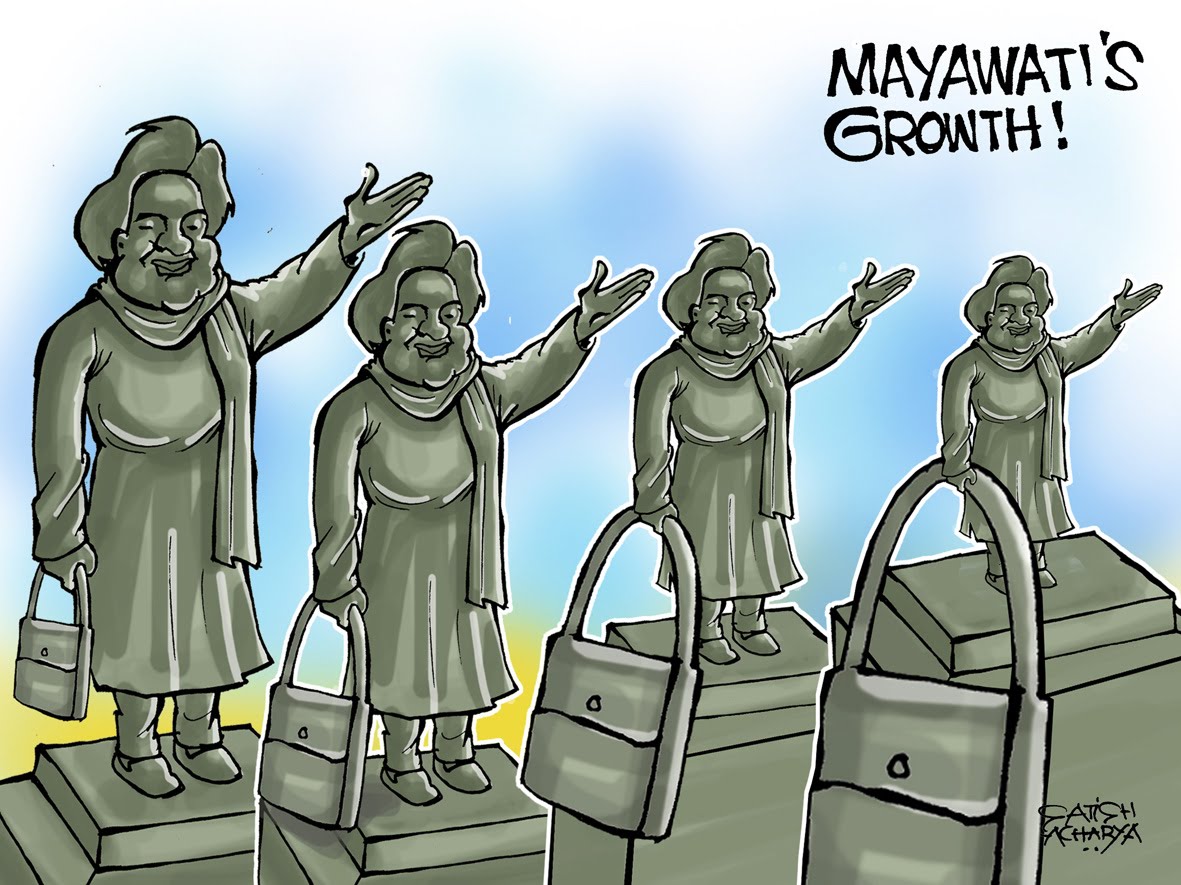
The Queen Maya Memsaab, who, according to Wikileaks, kept tasters before she munches anything and for whose convenience, a chartered plane is sent from Lucknow to Bombay, for fetching her favourite shoes, reminds me of my childhood hero, Cinderella, sort of or nothing short of it. This former primary teacher was first spotted by Kanshi Ram almost by an accident. The place was the Constitution Club, Delhi; time, September 1977, and the occasion was Abolish Caste Conference and the speaker was Raj Narayan, the then cabinet minister who was talking about saving the, ’Harijans’. This word was repeated often and the discomfort it caused in the air was palpable, but most preferred a diplomatic silence. But not so, for the twenty –one year old Primary teacher, her voice rose above all; Didn’t the honorable Minister know how Dr.Ambedkar had referred to these people as Scheduled Castes, in the constitution? The term, Harijan, was insulting, she insisted. Her voice was lonesome and quite a daredevilry act for an unmarried woman, Dalit at that, to be speaking so vociferously and openly against a cabinet minister. Kanshi Ram never could forget her after that and became her mentor, till his end. He was twenty-two years, her senior. Women politicians, in those times were rare to spot, more so from Dalits. The Maya story seems almost Cinderelleseque, a rise from ashes to the echelons of high power within no time.
From 1977 to the present 2012 The Maya story seems, unbelievable. That feisty courageous woman has now come to cry ‘foul’ frequently. The climax is reached when she is said to have employed tasters, before munching anything. Paranoid!  

Satish Acharya [Mayawati's growth]

Afraid of the demons, some her own creations and some imagined, she operates as a shadow of her former fiery self. The absurdism reaches its height when huge elephantine ambitions take the form of those crude outsized structures that seek to dwarf everyone around them, a phantasmagoria kind of thing. Ironically enough the disease by which thousands [Yes, thousands!] of young children die in Maya’s state is also known as Encephalitis! Its hard to miss the bleak resemblance in nomenclature.  It’s unbelievably irrational to see that when thousands are dying regularly and on an annual basis, these phantoms of elephants compete with the innocents to crop up, as they continue to die. The Cinderella of the yore has transformed sadly to become our own Hosni Mubarak, no less a dictator herself. How else can one explain this dichotomy of events which stand so starkly opposite to each other?  A weird twist, in the story comes, when the Election Commission ‘orders’ all the phantasmagorias to be covered till we are over with the elections!

Burning of the Book and the Great game

AIJAZ Z. SYED
Burning of the Book and the Great game

After spending 11 years and $500 billion dollars in Afghanistan, the Americans still don't get it

Are the Americans really that dumb? I mean after spending 11 years in the world’s most dangerous battlefield and dealing with the fiercely proud and famously hot-blooded Afghans you have to be stark, raving mad to be doing what the Americans were found doing last week.

Why is it so hard for the West to see that faith plays a pivotal role in Muslim societies and lives of the believers? The renunciation of faith may be the first step toward liberation for the West with its best and brightest minds, from Christopher Hitchens to Richard Dawkins, competing with each other to run down their Maker.

But what the West finds to be “delusional” is held in highest esteem by the Muslims. This reverence extends to the Book that they believe to be the last word of God and the Last Prophet, peace be upon him, who brought it. The faithful cannot imagine or tolerate slightest of slurs or affront against these icons. Anyone who has seen the Muslims handle the Book would know it.

They hold it with utmost reverence and do not even touch it unless they are in a state of purity. And when it comes to love and reverence for their faith and its icons, perhaps no one can outshine the Afghans.

When those spiteful caricatures surfaced in the scenic Scandinavia, they provoked spontaneous protests all around the world but the strongest of them were witnessed in Afghanistan.

Many died in the angry demonstrations that went on for weeks. History repeated itself when two years ago an attention-hungry pastor in the distant Florida vowed to make a bonfire of the Islamic scripture.

The Afghans are seldom known to allow a provocation go unchallenged. Killing and getting killed for honor and what is close to heart is all in a day’s work — or Pakhtoonwali (the Afghan way) for the ordinary Afghans. Not for nothing this land enjoys the reputation of being the “graveyard of empires.”

After spending more than a decade and $500 billion dollars in Afghanistan, not to mention the thousands of lives lost on both sides, it is hard to believe the Yanks didn’t know this already. So you have to be either totally stupid or utterly callous, or both, to incinerate the copies of the Book at the Bagram air base.

After days of protests and the unprecedented killing of many US troops including two senior US military personnel right inside the Interior Ministry by their Afghan allies, President Obama coughed up a terse apology: “I wish to express my deep regret for the reported incident. I extend to you and the Afghan people my sincere apologies.”

His commander in Afghanistan Gen. John R. Allen, who has issued an equally sincere apology, has directed that all US forces undergo 10 days of “sensitivity training in the proper handling of religious materials.”

Eleven years into this war — isn’t it a bit late for that, general? Besides, it’s not as though the Americans and their comrades in Afghanistan are exactly ignorant of Afghan and Muslim sensitivities. We have been here before, repeatedly, with similarly sensitive American shenanigans being followed by equally perfunctory apologies.

In 2005, Afghanistan was rocked by violent protests when there were reports of the Guantanamo Bay interrogators defiling the Qur’an as part of their methods of persuasion. Last year the Afghans were outraged by the revelations about the US ‘kill teams’ that hunted civilians for fun, duly capturing their Kodak moment for posterity standing over their ‘trophies’.

Why only recently when the Americans and Taleban representatives were sitting down for talks in Doha, there were these startling images of the four wisecracking US Marines urinating over dead Afghans. Other members of the ‘coalition of the willing’ haven’t been far behind. The cousins across the Atlantic, for instance, were found filming themselves abusing Afghan children.

This war for Afghan hearts and minds has gone alongside the bombing of Afghan homes and villages and even wedding and funeral processions.

Thousands of innocent civilians, according to UN agencies and independent rights groups, have perished in these attacks. The recent killing of eight shepherd boys, aged between eight and six, in a NATO airstrike in Kapisa province is but just one example.

Do we see a pattern here — a deliberate method in the madness? Does the upsurge in such ‘incidents’ have anything to do with the timing of the US-Taleban engagement following the efforts of some Arab and Muslim countries? Anything is possible.

There are many out there, including those in the US military establishment, with strong motives to derail all efforts to end this disastrous war.

Given the high stakes involved in the so-called Great game and Washington’s keenness to maintain its presence in this strategically critical region, not to mention the yet-to-be-tapped rich mineral resources that Afghanistan has hidden in its belly, possibilities are endless.

This week, conservative pundit Patrick Buchanan was livid over Obama’s Qur’an apology. In an angry opinion piece, he points to the fact that the US has squandered hundreds of billions of dollars and thousands of American lives in Afghanistan, raising the inevitable question: For What, These Wars? For what, indeed? Well, here’s why.

Afghanistan provides Uncle Sam with a rare vantage point to keep a resurgent Russia and a clever China on the one hand and an irrepressible Iran and pesky Pakistan, on the other, in check.

The US already has an overwhelming presence in the Gulf, the energy bowl of the world. The 9/11 was merely an excuse and a rather convenient opportunity.

But then the Americans are not the first to enter Afghanistan with such ambitions and, some would say, delusions of grandeur. The British and more recently the Russians have been there before them, not to mention numerous others, from the Greeks to the Mongols. While the crafty British had to give up after several disastrous and humiliating attempts, the Afghan occupation cost the Russians the Soviet empire.

Do the Americans, after a disastrous decade in Afghanistan, really think they can succeed where all others failed? It had always been a doubtless enterprise. But with the sweetness and light that the coalition of the willing has been forever spreading around, it is doomed.

That Uncle Sam will have to leave sooner or later is not a matter of debate. It’s a certainty.

What remains to be seen is how the Americans go — the way the British left with egg in their face or in the manner the Russians departed, bruised and battered with their empire crumbling around them.


— Aijaz Zaka Syed is a Gulf-based commentator. Write him at aijaz.syed@hotmail.com